


An extract from “History in English Words” by Owen Barfield, also marking its centenary, first published in 1926
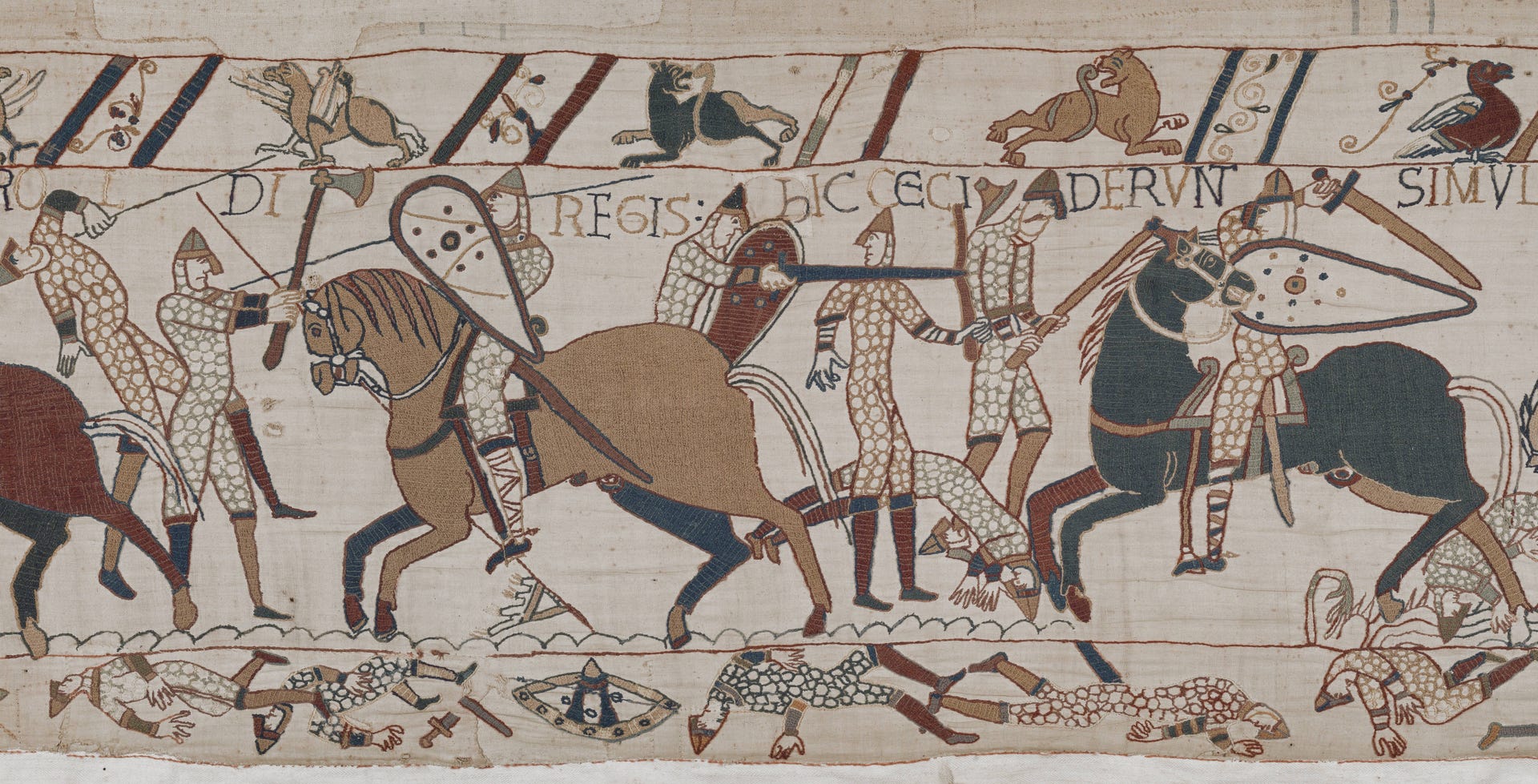
“And now there followed an event which has had more influence on the character of the English language than any other before or since. The conquest of England by the Norman invaders brought about an influx of French words which went on increasing in volume for more than three centuries.
“At first it was little more than a trickle. For a long time the Norman conquerors did not mix much with their Saxon subjects. There are plenty of indications of this; for the languages, too, moved side by side in parallel channels. The custom of having one name for a live beast grazing in the field and another for the same beast, when it is killed and cooked, is often supposed to be due to our English squeamishness and hypocrisy. Whether or no the survival of this custom through ten centuries is due to the national characteristics in question it would be hard to say, but they have certainly nothing to do with its origin. That is a much more blameless affair. For the Saxon neatherd who had spent a hard day tending his oxen, sheep, calves, and swine, probably saw little enough of the beef, mutton, veal, pork, and bacon, which were gobbled at night by his Norman masters.
“There is something a little pathetic, too, in the thought that the homely old word, stool, could be used to express any kind of seat, however magnificent, until it was, so to speak, hustled into the kitchen by the smart French chair. Even the polite, however, continued to use the old word in the idiom “to fall between two stools.”
“Master, servant, butler, buttery, parlour, dinner, supper, and banquet all came over with William, besides the names of our titular ranks, such as duke, marquis, viscount, baron, and countess. The French word ‘comte’ was evidently considered to be equivalent to the one existing Anglo-Saxon title, earl, with the result that count never became an English rank. But since it had not been the Saxon custom to give ladies titles corresponding to those of their lords, the word countess was able to fill an important gap.
“That the Feudal System had an educative value and played its part in creating modern ideals of conduct is suggested by such words as honest, kind, and gentle, which meant at first simply ‘of good birth or position’ and only acquired during the Middle Ages their later and lovelier meanings.
“Not the least interesting of the words that must have come over from France about this time are such courtly flower-names as dandelion and pansy, from ‘dent-de-lion’ (describing the ragged leaves) and the sentimental ‘pensée’—remembrance.
“Many of these early Norman words seem to have a distinctive character of their own, and even now, after nearly a thousand years, they will sometimes stand out from the printed page with peculiar appeal. Perhaps this is especially true of the military vocabulary. That sharp little brightness, as of a window-pane flashing just after sunset, which belongs to the ancient, technical language of heraldry, such as argent, azure, gules, ... sometimes seems to have spread to more common Norman words—banner, hauberk, lance, pennon, ... and—in the right mood—we can even catch a gleam of it in everyday terms like arms, assault, battle, fortress, harness, siege, standard, tower, and war. The Norman-French etymology of curfew (couvre-feu, cover fire) is too well known to require comment.
“It will be noticed that nearly all these words are directly descended from the Latin, beef going back through ‘boeuf’ to ‘bov-em’, master to ‘magister’, duke to ‘dux’,... Thus already, by the thirteenth century, we can trace in our vocabulary four distinct layers of Latin words. There are the Latin words learnt by our ancestors while they were still on the Continent, such as camp, mile, and street; there are the Latin words brought over by the Roman invaders, of which port and Chester were given as surviving examples; and thirdly there are those words—altar, candle, nun, ... brought over by the Christian missionaries as described earlier in this chapter.
“These three classes are reckoned to account for about four hundred Latin words altogether; and lastly there is this great deposit of Norman-French words, of which the number must have been running into thousands. For it was not only terms of general utility which were transferred from one language to another. A second and entirely different kind of borrowing now sprang up—the literary kind.
“For two or three centuries Poetry and Romance had been making rapid strides in Italy and France. The medieval habit of writing only in Latin was dying out and Dante in Italy and Du Bellay in France had both written treatises extolling the beauties of their native tongues. French lyric poetry burst into its early spring blossom among the troubadours, with their curious “Rose” tradition, and for two hundred years the English poets imitated and translated them as fast as ever they could…
“A modern poet, looking back on that time, can scarcely help envying a writer like Chaucer with this enormous store of fresh, unspoilt English words ready to his hand and an unlimited treasury across the channel from which he could pick a brand-new one whenever he wanted it.
“Thou hast deserved sorer for to smart, / But pitee renneth soone in gentil heart.” [From The Knight’s Tale: “You have deserved to suffer more painful punishment, / But pity runs quickly in a gentle heart.”] Here are three Norman-French borrowings, three fine English words with the dew still on them, in two lines. It was the May morning of English poesy.”
Extract from “History in English Words” by Owen Barfield (Faber & Faber, 1953)
A wonderful read—thank you. I love etymological romps and discovering the histories words carry. Words being alive after all.
"The French word ‘comte’ was evidently considered to be equivalent to the one existing Anglo-Saxon title, earl, with the result that count never became an English rank"
It was my understanding that the reason for this may have been more to do with the fact that "comte" sounded a bit too much like a particularly insulting existing Anglo-Saxon epithet, and this was why it never took off